|
Aurora, Illinois, USA
NWP award-winning essay authored by Aarin.
2025 First Runner-Up
|
In my neighborhood, rain is synonymous with flooding. Every spring, showers and thunderstorms leave behind flooded plains and frustrations for community members. Water pools in front of houses and turns valleys into ponds. After doing some research, I learned that the reason is the lack of prairies and native plants--critical to absorbing rainwater, protecting local biodiversity, and absorbing carbon dioxide. It's ironic, considering that Illinois, the prairie state, has only 0.01% of its original prairie left. From a young age, I've always been passionate about the environment, and learning about this local problem inspired me to complete an Apprentice Ecologist Project.
The project I conducted was in my local area of Aurora, Illinois, and Oswego, Illinois--both of which are heavily affected by the loss of Illinois' native prairies. This destruction was caused by the encroachment of steel factories, the creation of farmland, and other industrial activities in the 19th and 20th centuries. Native plants have been replaced with grass or non-native plants such as corn and soybean which have short, inch-long roots impeding water absorption, leading to flooding and surface water pooling. This loss of prairies has severely endangered numerous animal and insect populations that depend on this habitat for food, water, and shelter. Moreover, it worsens water quality, as non-native plants can't percolate water deep enough for it to be clean, filtered, and untouched by agricultural run-off.
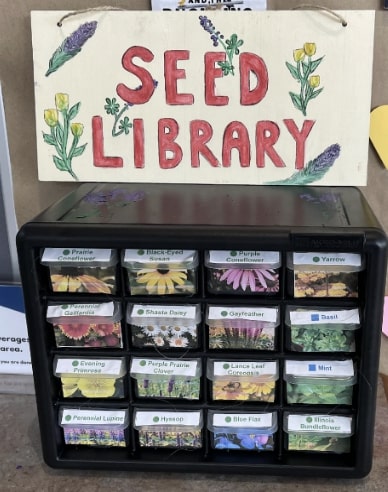
Seeing the inaction surrounding this issue and the lack of resources in my area, I cofounded a non-profit called Seeds of Hope in 2023 which fosters individual environmental activism by placing native plant seeds in the hands of students and other community members. This is achieved through seed libraries, containers with 16 different drawers, each stocked with 5 to 10 packets of native seeds. Each packet contains seeds and is labeled with all the necessary growing information such as germination time and amount of sunlight needed. We added informational posters next to each library to raise awareness for the problem and promote environmental education. We restocked these libraries periodically and all the seeds are free and located in accessible areas allowing anyone to help restore prairies in their community.
Our strategy revolves around the fact that instead of a one-time project like many cleanup and planting events, our organization plants the "seeds" of environmental activism in youth, exponentially increasing our impact. With Seeds of Hope, people take the seeds, tell their friends and families, and our impact spreads through word of mouth. More and more people want to get seeds and spread seed libraries. More and more people want to get involved with environmental action. We have the true power of change in just one little packet of seeds. We can take back our planet one seed at a time and plant a seed of hope for our Generation Z.
Seeds of Hope aims to raise awareness about the state of our prairies and the environmental benefits of planting native plants instead of non-native ones while also getting local community members involved. Currently, we have already implemented five seed libraries in three local high schools and two public libraries, distributing 8,340 native plant seeds, with around 5,000 of those during 2024, to students and community members. Sharing our mission with the world, we've received $5,000+ in grants from T-Mobile Changemakers and Battelle Climate Challenge.
Recently, Seeds of Hope was featured in a Daily Herald article and we gained lots of community support and exposure. It has been so exciting to see students, teachers, and community members alike eagerly share photos of their native gardens with us. So many people have volunteered their time to create the inaugural seed libraries, and more and more students are taking native seeds to plant. We have already worked with over 50 student volunteers to create and sort the seeds for our initial seed libraries. As more people hear about Seeds of Hope, additional high schools and public libraries are contacting us asking how they can receive a seed library. I hope to continue expanding this initiative by creating new seed libraries and working towards our ultimate mission of combating climate change and inspiring youth activism.
Through creating Seeds of Hope and leading this Apprentice Ecologist project, I've learned just how important it is to protect our prairies, which are critical to both animals and humans alike. By giving community members and the public access to native seeds, I've been able to raise awareness about the state of our prairies and give people a way to help. This project has made me realize that in the future, I want to be an environmental scientist, creating meaningful impact and protecting the Earth at the same time. In the end, I'm proud of Seeds of Hope and everything it stands for fostering individual environmental activism by placing seeds in the hands of students and other community members. I'm proud that I can teach others how to take charge and inspire positive change in our local community. Above all, I'm proud to lead a grassroots initiative that is working to restore Illinois' prairies--one seed at a time.
|